
Sex Offender Checks in Sanilac County
The Michigan State Police manages the Michigan Public Sex Offender Registry, or PSOR, under the Sex Offenders Registration Act. PSOR is the authorized public subset of a larger law-enforcement registry. It is the main channel for a Sanilac County registry check. Search the county filter or a local address and radius, then open the relevant profile rather than relying only on a map marker.
The registry can be busy and may have brief access interruptions. A lack of results does not prove that no person has a past offense. Michigan law limits which records are posted, how long they remain, and which statuses are public. The Sanilac County Sheriff can address local registration or reporting questions, while suspected data errors can be sent through a profile's tip function or the police agency responsible for the listed address.
Sanilac Registry Questions and Reports
The Sanilac County Sheriff is the local contact for registration and reporting questions. The office is at 65 N. Elk St., Sandusky, MI 48471, and its main phone is 810-648-2000. Sanilac County does not publish a dedicated registration-counter schedule, so call before visiting. The office can direct a question to the right local function but cannot replace the official PSOR profile or give legal advice.
Sanilac County Sheriff
65 N. Elk St.
Sandusky, MI 48471
810-648-2000
Call for current registry-counter routing.
Report suspected noncompliance to the law-enforcement agency where the person actually resides or to MSP. An immediate threat belongs with 911. Do not investigate at the listed address, confront a registrant, or post a private compilation of profile data.
How to Search the Michigan Public Sex Offender Registry
The Michigan PSOR search supports both identity and geographic queries. Partial first and last names can be used together. Registration or MDOC numbers provide alternate identifiers. A location search can use a street with a city, county, or ZIP, while the neighborhood tool supports several radius choices. Select Sanilac County to keep the results local.
- Open PSOR and review the conditions for lawful public use.
- Choose a name, registration-number, MDOC-number, county, ZIP, or address search.
- For neighborhood results, select an address and supported radius, then review the list and map.
- Open the full profile and compare name, photograph, status, offense, and registration details.
| Field Label | Type | Required | Notes |
|---|---|---|---|
| First and last name | Text | Yes for name search | Partial names are accepted |
| Registration number | Text | Alternative | Can identify a registry record |
| MDOC number | Text | Alternative | Use registration or MDOC number |
| Street address | Text | Conditional | Add city, county, or ZIP |
| County | Dropdown | Optional | Select Sanilac for county results |
| Neighborhood radius | Dropdown | Yes for radius mode | 0.25, 0.5, 1, 2, or 5 miles |
| Status lists | List option | No | Published, incarcerated, or non-compliant lists |
The live PSOR source shows the search interface used for Sanilac County results.
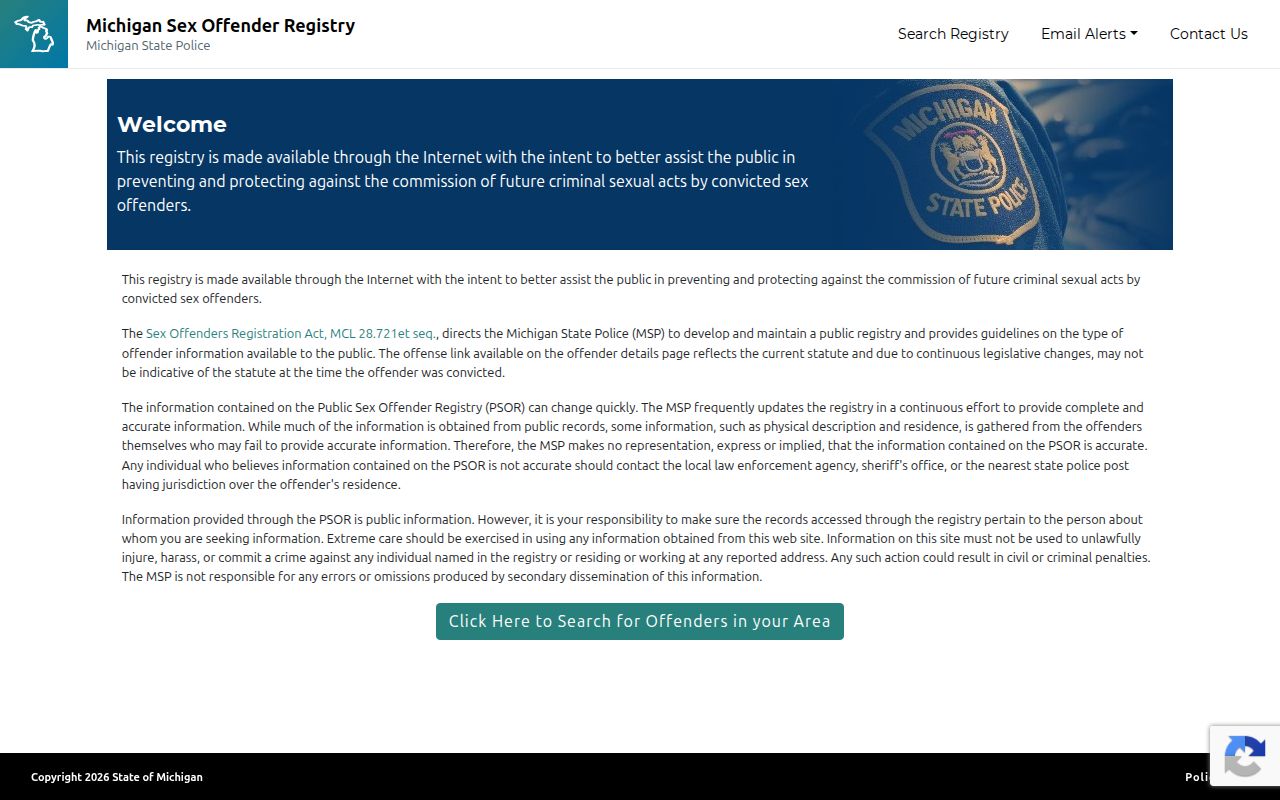
The search form's county, address, identifier, and radius choices support both a focused name check and broader neighborhood awareness.
Sanilac PSOR and NSOPW Searches
PSOR is the best first source for a Sanilac County sex offender search because MSP manages the Michigan data and explains its own status fields. The Dru Sjodin National Sex Offender Public Website, or NSOPW, adds a cross-state layer by searching participating public registries. It is useful when a name or location history crosses Michigan's borders.
These sources should be compared, not treated as two copies of one database. States set their own public-posting rules, data can update on different schedules, and a national result links back to the participating jurisdiction. For any Sanilac County profile, return to Michigan PSOR for the state-specific status, tier context, and tip tools.
The official NSOPW search illustrates the national public-registry layer.
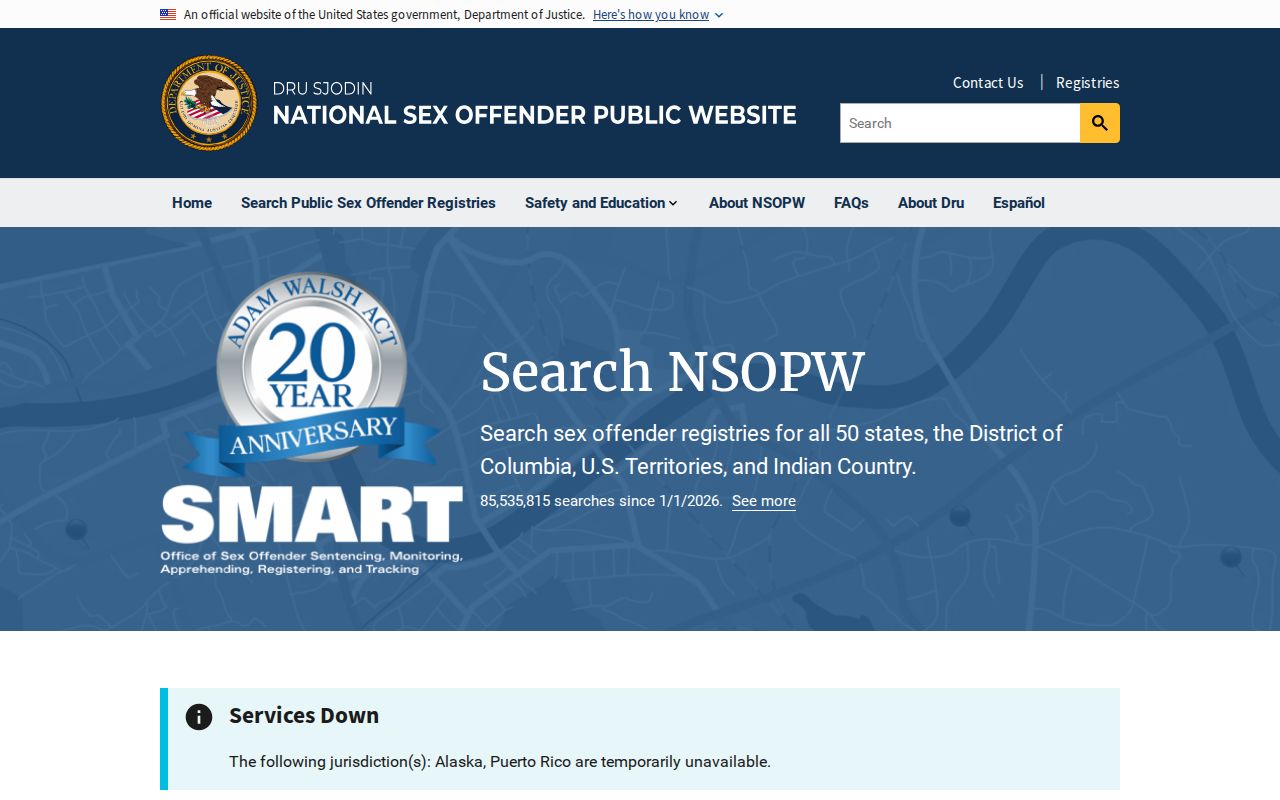
The national interface widens a search without replacing the Michigan registry that supplies the local record.
Note: When the two systems differ, verify the Sanilac County entry through Michigan PSOR and the responsible local registering agency.
Inside a Registry Profile
A public profile groups identity, status, offense, and location fields that Michigan law permits for release. Read the whole entry. A photograph helps with visual identification, while aliases and birth information can separate similar names. Status and verification fields explain whether the person is active, incarcerated, out of state, homeless, or in another listed category. A gray map button can simply mean the address is not mapped.
| Name & Aliases | Lists published identity names and alternate names tied to the registration. |
|---|---|
| Photo & Description | Shows a published photograph, physical traits, scars, marks, and tattoos where available. |
| Address Information | Displays residence or other lawful location details; mapping may not always be enabled. |
| Offense & Statute | Identifies the registerable offense and conviction information shown by PSOR. |
| Tier | Shows the offense-based statutory category, not a personal prediction of future conduct. |
| Registration Status | Provides published status and last-verification information where displayed. |
| Other Registered Data | May show campus, vehicle, or other information required by Michigan law. |
A PSOR entry is not a full court file. It will not supply every pleading, hearing, or sentence document. For the prosecution and disposition, search the proper Sanilac County court and request the public file from its clerk.
Missing Sanilac Registry Search Results
A person can lawfully be absent from public PSOR for several reasons. The matter may involve juvenile status, death, nonresidency, a nonlisted or pre-1995 circumstance, judicial removal, set-aside, HYTA status, an expired registration term, or an offense excluded from public posting. The public registry is not the full confidential law-enforcement registry. Absence cannot establish that no prior offense exists.
- Active
- A currently published registration status under Michigan's registry process.
- Absconder
- A published status indicating the registering agency cannot confirm required whereabouts.
- Homeless
- A status used when a registrant reports no fixed residence under the applicable process.
- School Only and Other Limited Statuses
- Limited Michigan connections that can create specific registration duties.
Do not infer a person's present conduct from a tier or status label. Michigan tiers are tied to statutory offense categories. If profile data seems wrong, use “Submit a Tip” on the profile or contact the agency responsible for the registered address.
Michigan Registration Levels and Requirements
Michigan uses three offense-based tiers. The law sets general duration and verification patterns, but exceptions can change an individual's term. Check the offense and relevant dates under MCL 28.722 instead of guessing from the offense name alone. Tier placement is a legal category and does not measure the likelihood of future conduct.
| Tier | General Duration | Verification Concept |
|---|---|---|
| Tier I | 15 years, subject to statutory exceptions or reduction | Annual |
| Tier II | 25 years | Twice yearly |
| Tier III | Life | Quarterly |
Michigan materials state that residence, work, legal-name, and higher-education changes generally must be reported in person within three business days. Temporary lodging longer than seven straight days, vehicle changes, and phone changes may use permitted channels within three business days. Interstate and international moves have separate advance-reporting rules. Current official material also describes a $50 initial fee and $50 annual fees until the total reaches $550.
Sanilac County Registry Email Alerts
PSOR Email Alerts can watch an address in or near Sanilac County. The workflow asks for a physical or home address and an email address, then offers radii of 0.25, 0.5, 1, 2, or 5 miles. After the user accepts the terms, a confirmation normally arrives within 24 hours. More than one physical address can be tied to one email account.
An address alert is triggered when a published registrant moves, enrolls in school, or reports work inside the selected radius. “Track Offender” serves a different purpose: it follows changes tied to a particular public profile. Choose the address alert for neighborhood awareness and profile tracking when a specific lawful public entry needs monitoring.
The MSP sex offender registry guidance explains Michigan's public search, reporting framework, and registry use.
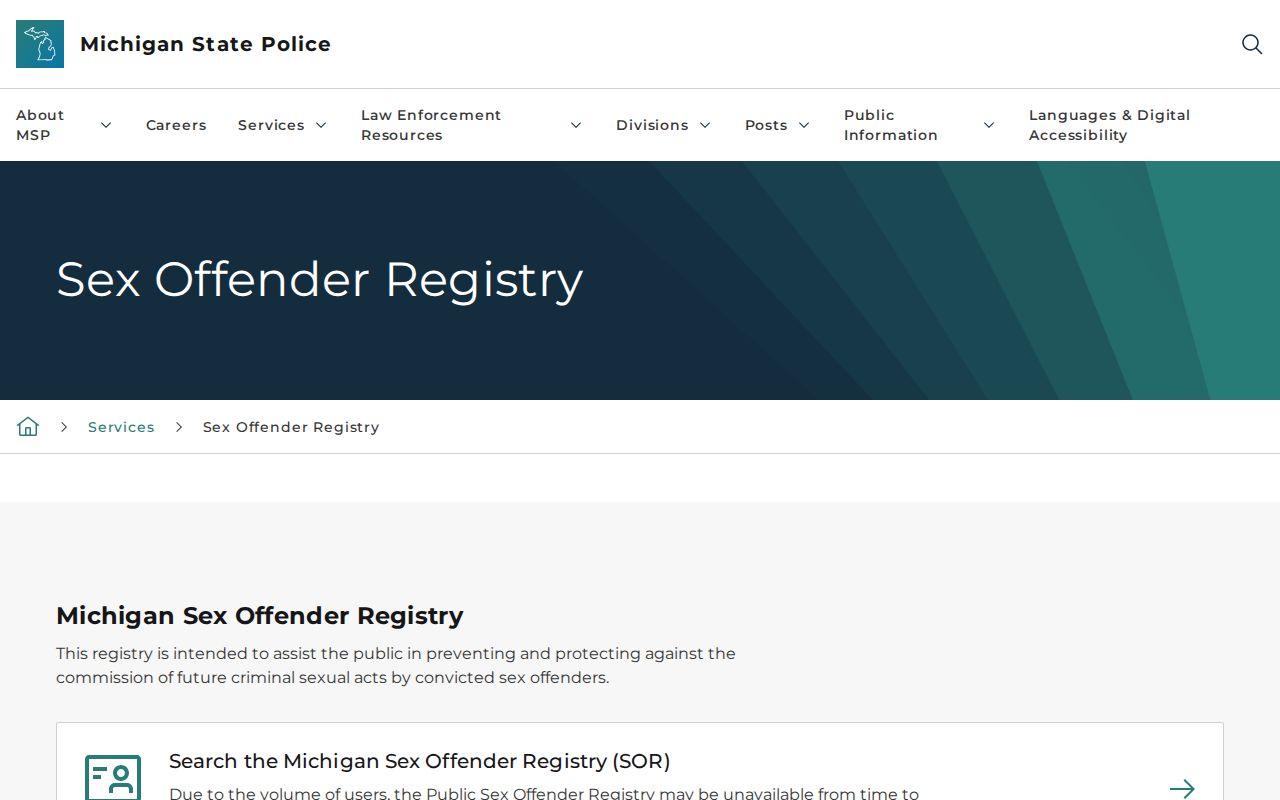
The MSP guidance gives state context that a short alert email or map result cannot provide by itself.
Sanilac Registry Residency Rule Myth
Michigan repealed the former SORA student safety zone rules, including the old school-distance residency, work, and loitering provisions, effective March 24, 2021. No current statewide SORA school-distance rule or Sanilac County replacement ordinance was located. Repeating the former 1,000-foot rule as current law would be wrong.
The official repealed SORA division index documents that change. Current duties should be checked in the active statute and official MSP guidance. A map can support awareness, but its distance circle is a search tool, not proof that an address violates a residency rule.
Note: The PSOR neighborhood radius filters search results; it does not create a legal exclusion zone around the chosen address.
Community Notification and Lawful Use
Registry information supports personal, family, and community safety. Review the official entry, use address alerts, and report suspected noncompliance through law enforcement. Do not confront the person or household. Threats, vigilantism, harassment, and unauthorized use of confidential registry information can produce criminal or civil consequences. MCL 28.730 controls the confidentiality and authorized release of underlying registration reports, while PSOR is the public subset released under SORA.
Use registry data lawfully: Misusing PSOR information to harass, threaten, or intimidate is unlawful. MCL 28.730 also restricts unauthorized disclosure or use of confidential registry information.
For an apparent error, use the profile tip function or contact the police agency tied to the registered address. Report suspected failure to comply where the person actually resides. Call 911 only for an emergency. Public data can be incomplete or delayed, so confirm material facts with the originating registry or court before relying on them.