
Sanilac County Criminal Court Cases
Sanilac County uses two courts for most criminal prosecutions. The 73A District Court handles misdemeanors, traffic matters, civil infractions, and the first stages of felony cases. Those felony stages include arraignment, the probable-cause conference, and the preliminary examination. If the judge binds a felony over, the prosecution moves to the 24th Circuit Court for trial-level work. A misdemeanor will usually remain in District Court from filing through disposition.
Both courts are based at 60 W. Sanilac Ave., Sandusky, MI 48471. The County Clerk serves as clerk of the Circuit Court and is the main counter for bound-over felony records and certified circuit documents. District Court maintains its own files for misdemeanors and felony preliminary proceedings. The same name and incident can thus appear under two case numbers. A searcher should record the court, case number, and status for each result before asking for a copy.
Two Sanilac Court Case Trails
A felony can leave a district record even after the case moves to Circuit Court. The district trail shows why the accused first appeared, the initial charge, bond rulings, probable-cause events, and whether the case was dismissed or sent onward. The circuit trail begins after bindover and holds the information filed by the prosecutor, later motions, pleas or trial events, judgment, and sentence. Reading only one trail can hide the outcome.
This split also prevents a common error. A district entry marked closed does not always mean that the whole prosecution ended. It can mean the preliminary phase closed because the felony moved to Circuit Court. By contrast, a district dismissal may end the charge before bindover. Match names, dates, charge text, and linked case details, then confirm the final disposition with the clerk. The broader Sanilac County arrest lookup explains why the arrest charge may differ from the charge the prosecutor ultimately files.
Note: A district case number should never be treated as the final felony record without checking the 24th Circuit Court trail.
Searching Sanilac County Case Records
MiCOURT Case Search is the first online channel for Sanilac County court cases. It is free and covers public case-management data from participating courts. The court selector matters. Search 73A District Court for misdemeanors and early felony activity, then search 24th Circuit Court for any felony that may have been bound over. Name spelling can affect a result, while a known case number gives the cleanest match.
- Open MiCOURT and accept the terms for public case data.
- Select 73A District Court, then search by party name or case number.
- Repeat the search in 24th Circuit Court when the matter may be a felony.
- Read the register of actions, status, charge, hearing, and disposition fields together.
- Contact the responsible clerk for the filed papers, a plain copy, or a certified copy.
| Field Label | Type | Required | Notes |
|---|---|---|---|
| Court | Selection/search | Yes | Choose 73A District or 24th Circuit |
| Search by | Tab or option | Yes | Party name or case number where enabled |
| Last or business name | Text | Conditional | Spelling affects the match |
| First name | Text | Optional | Helps narrow common names |
| Date of birth | Date | Optional | Use only when the portal exposes it |
| Case number | Text | Conditional | Use the court-specific format |
MiCOURT Case Search Limits
MiCOURT is an index, not a promise that every case document can be opened online. A participating court controls its data. Document images may be absent, an event may post after a delay, and sealed or nonpublic proceedings will not appear. Electronic filing through MiFILE is also different from public document access. A filing tool lets authorized users send papers to a court; it does not turn the complete Sanilac County case file into a public download.
When a result is missing, search both courts and check name variants that are legitimately known. Then contact the court that should hold the stage of the case. Give the clerk the case number if possible, along with the name and an approximate year. Ask whether the file is public, whether it is stored off site, and what a plain or certified copy will cost. Sanilac County did not publish a stable criminal-copy fee in the research, so obtain a written quote instead of assuming a price.
Inside a Sanilac County Case File
A criminal case file documents the prosecution, not just the arrest. It may contain the complaint, prosecutor's information, notices, motions, orders, plea papers, trial events, judgment, sentence, and a register of actions. Public online data often summarizes those items without supplying each filed page. The register is a dated event list, while the underlying document gives the text of the filing or order.
| Case Number & Court | Identifies the court file and separates district proceedings from the circuit prosecution. |
|---|---|
| Charging Document | States the filed offenses, statutory citations, and allegations presented to the court. |
| Docket Entries | Lists complaints, conferences, examinations, motions, pleas, orders, and later events by date. |
| Hearing Dates | Shows scheduled court activity and the judicial officer when public. |
| Disposition & Judgment | Records dismissal, acquittal, plea, conviction, or another final result. |
| Sentence & Conditions | Shows jail or prison terms, probation, fines, costs, and other court-ordered conditions when public. |
Protected personal data, victim details, juvenile material, and sealed records do not belong in the public view. Financial obligations may appear where the case system exposes them, but payment data should not be confused with the criminal disposition.
Older Sanilac Court Case Files
An older Sanilac County court case may predate the public index or lack a complete digital trail. Start at the responsible clerk with the name, approximate year, court, and any known case number. Ask the County Clerk for a felony file after bindover and 73A District Court for a misdemeanor or felony preliminary file. Specify whether inspection, a plain copy, or a certified copy is needed. Certification is a clerk's formal attestation, not a broader or more detailed search result.
The Sanilac County Clerk page is the official circuit-record access point. Its online view also helps confirm which office should receive a request.
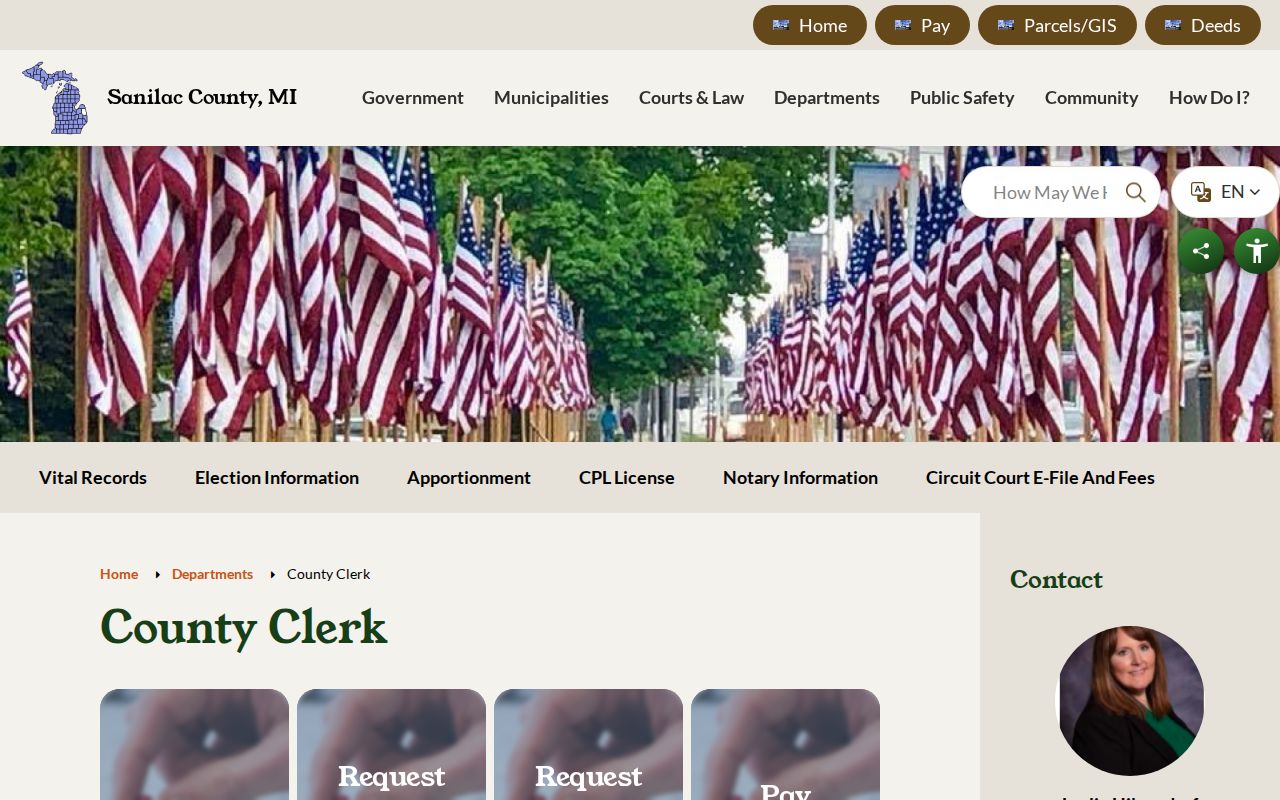
The clerk image connects the web search to the office that can locate the actual circuit file and issue a certified record.
For historical research, official archive guidance identifies Sanilac criminal docket books from 1928 through 1943 among preserved materials. Those volumes serve genealogy and court-history work, but they are not substitutes for a current case search. Confirm custody with the clerk or Archives of Michigan before planning a records visit.
How a Criminal Case Moves
Sanilac County criminal cases do not all pass through every stage. A summons can replace an arrest, a prosecutor can decline or change charges, and a district dismissal can stop a felony before bindover. For a felony that continues, the district judge handles the first hearing and probable-cause process. After bindover, the Circuit Court handles the trial-level charge, motions, plea or trial, judgment, and sentence.
Case flow: Charges Filed › Arraignment › Pretrial › Plea or Trial › Disposition › Sentencing
Post-judgment work can add probation violation proceedings, a new sentence order, or an appeal. A bench warrant may also appear when a person misses court or violates an order. Each event should be read in date order. The latest docket line is useful, but it should be checked against the judgment or order that gives the ruling its legal effect.
Reading Sanilac Court Action Registers
A register of actions uses short labels to show how a case moved. “Arraignment” is the hearing where the charge is stated and a plea is addressed. A “probable-cause conference” is a district event in a felony track. A “preliminary examination” tests whether the felony should proceed, while “bindover” sends it to Circuit Court. “Disposition” means the result of a charge, not merely the date the file closed.
- Complaint
- The initial charging paper used to start a criminal court case.
- Information
- The prosecutor's felony charging document filed in Circuit Court after bindover.
- Register of actions
- The dated index of filings, hearings, orders, and rulings in the court file.
- Judgment
- The court record of the final adjudication and sentence.
A closed status by itself does not tell whether the charge was dismissed, resolved by plea, tried, or transferred. Read the disposition text and the last judgment entry. If the short text is unclear, ask for the underlying order rather than guessing from a code.
Fixing Sanilac Court Disposition Gaps
Court data and the Michigan State Police repository can fall out of step. A qualifying arrest may reach MSP before the prosecutor or court disposition is matched to it. If a person's own ICHAT result appears unresolved, obtain the final Sanilac County judgment or register of actions first. Ask the reporting court or agency to correct its source data, then follow MSP's correction channel. Michigan publishes the RI-027 Judicial Correction Worksheet for a court that cannot update a disposition electronically.
The source order is key. A portal screen cannot replace it, and a name match alone does not prove identity. For a full self-review, a fingerprint-based Michigan record review offers a stronger identity match than a public name search. Keep the court case number, the dated disposition, and any correction correspondence together so that the record can be traced across systems.
Note: Correct the originating Sanilac court record before asking a downstream repository to change its version of the disposition.
Case Record Access & Restrictions
Michigan Court Rule 8.119 and clerk procedure govern access to court files. Courts are not ordinary executive agencies subject to the same FOIA path used for sheriff reports. Public court material can be inspected or copied through the court, but sealed cases, juvenile matters, victim identifiers, and protected personal information remain restricted. Online redaction can also be broader than what a clerk may release after review.
The Michigan FOIA exemptions still matter for agency records tied to a case, such as an investigative report. Those records can be withheld when release would interfere with a proceeding, invade protected privacy, expose a confidential source or method, or endanger safety. Request the court pleading from the court and the police report from the agency that created it. One custodian is not required to build a new compilation from records held elsewhere.
If a Sanilac County criminal court case does not appear, do not infer that no proceeding exists. Search each proper court, allow for data lag, and ask the clerk whether a case is old, non-indexed, sealed, or filed under a different lawful name. The clerk can also explain the current copy method and quote, but cannot give legal advice about the case.